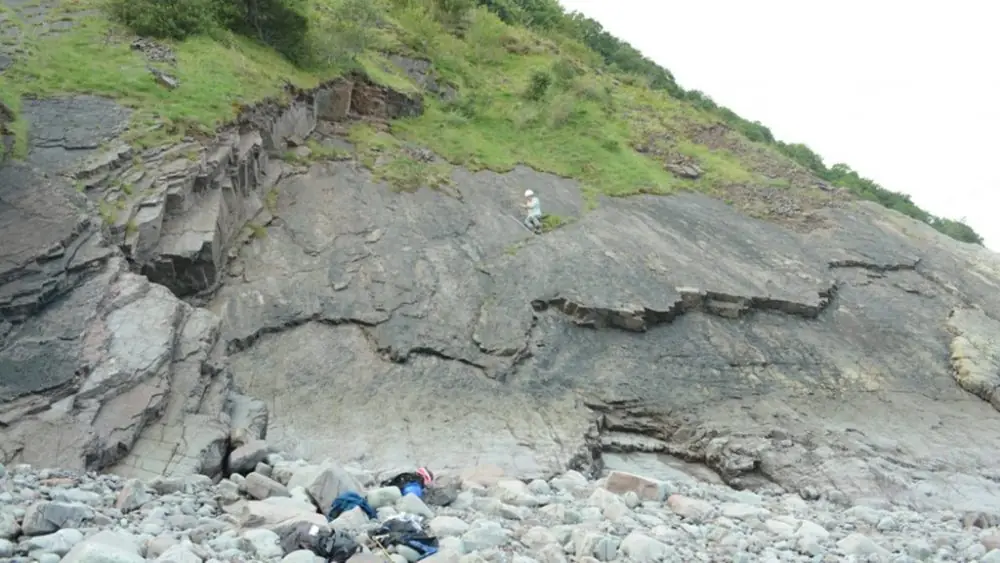
Near the welcoming backdrop of a Butlin’s holiday camp, within the embrace of towering sandstone cliffs, lies evidence of the world’s earliest known fossilized forest. This revelation, brought to light by diligent researchers from Cambridge and Cardiff Universities, not only redraws the boundaries of our historical knowledge but it also captivates the imagination with visions of an ancient world.
The scene of this extraordinary find is nothing short of a paleontological treasure trove. Among the natural beauty of the cliffs, scientists have unearthed fossilized remnants of a forest that predates any other known to science. The protagonists of this ancient ecological tale are trees known as calamophyton, which bore a striking resemblance to the palm trees we are familiar with today.
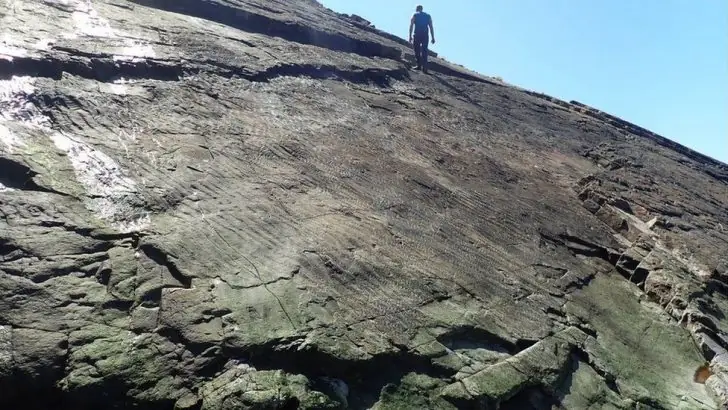
Nonetheless, this discovery is not merely about the trees themselves. It is also about the traces of roots and scattered plant debris that accompany them. Together, they weave a story of an ecosystem that flourished hundreds of millions of years ago, during the Devonian Period, a time when life was making significant inroads onto the land.
The Geological History of the Discovery
The fossil forest discovered in Minehead is not just a local curiosity. It has global significance. By dating back to a period between 419 and 358 million years ago, these fossils have pushed back the clock on the known age of terrestrial forests, making this site approximately four million years older than a previously identified fossil forest in New York State.
This era, rich in evolutionary advancements, is emblematically linked to Devon, a connection made due to the discovery of marine rocks from the period off its coast.
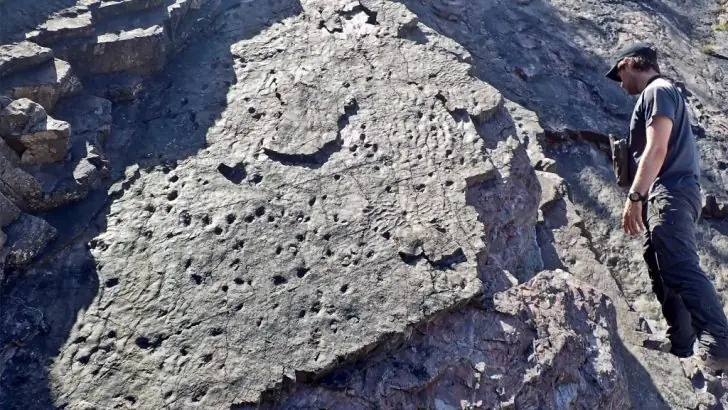
The researchers involved in this groundbreaking study have painted a picture of a world vastly different from our own. The area, now part of England, was once a semi-arid plain linked not to the British Isles but to what is now parts of Germany and Belgium. This fascinating twist reveals a past where continents as we know them were unformed, and the land that would become Britain was part of a completely different geographical narrative.
The Ancient Architects of the Landscape
The significance of this discovery extends far beyond the mere dating of ancient flora. The fossilized calamophyton trees and the ecosystem they represent offer profound insights into how early plant life influenced the shaping of Earth’s landscapes. These ancient forests played a crucial role in stabilizing riverbanks and coastlines, preventing erosion, and creating habitats for other forms of life to flourish.
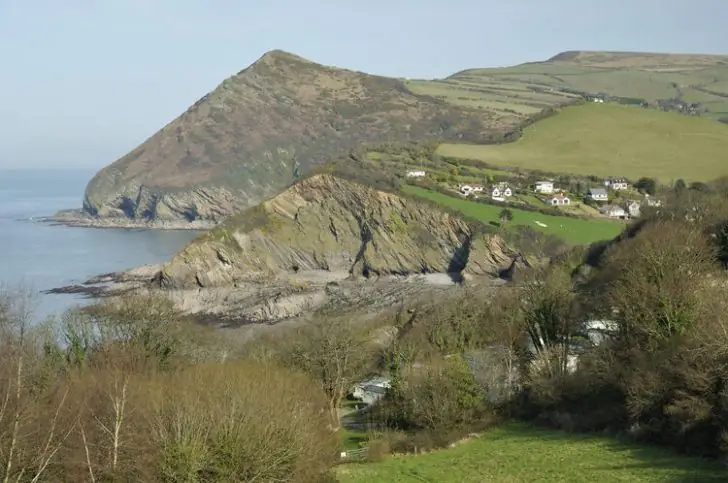
Stumbling upon the world’s earliest fossilized forest is akin to finding a time machine that transports us back to an epoch when the foundations of today’s ecosystems were being laid.
Remember, the discovery in Minehead does more than add a new chapter to our planet’s history. It offers a vivid glimpse into the dynamics of ancient life. Plus, it serves as a reminder of the resilience and adaptability of life, qualities that have seen it through countless challenges over the millennia.