
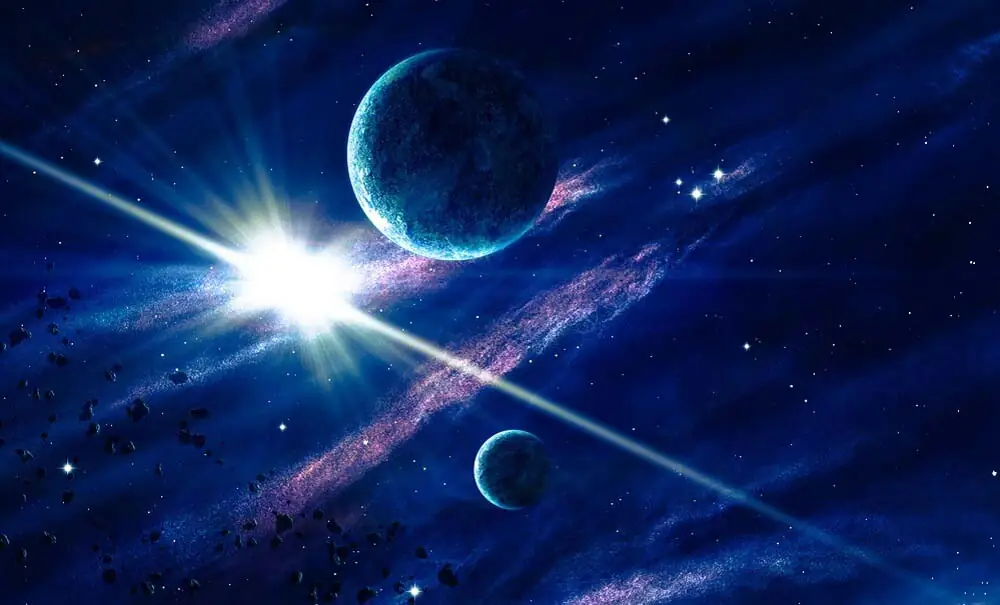
When the Beatles sang ‘Lucy in the Sky with Diamonds’, they were likely speaking metaphorically.
But based on the recent findings of a study published in The Planetary Science Journal, the Fab Four might have actually been onto something. As it turns out, the sky might actually be filled with diamonds.
Diamond Planets
Bjoern Wylezich/Shutterstock: Diamonds are formed 100 miles below the Earth’s surface
While diamonds are a rare commodity on Earth, the precious stone can be found in great abundance in other corners of the universe.
According to research by a team from the University of Chicago and Arizona State University, planets that have high carbon-to-oxygen ratios can form huge quantities of diamonds if they also have water. Known as carbide exoplanets, these celestial bodies reportedly have the conditions to create troves of diamonds beneath their surfaces when high heat and pressure are also present.
In fact, the researchers even believe that these planets might actually be made primarily of the precious stone. Even more interesting is that there might be trillions of these ‘diamond planets’ in the universe, according to the study’s lead author Harrison Allen-Sutter.
Carbide exoplanets reportedly contain more carbon than what is found on Earth. Scientists also theorize that they contain silicon carbide near their cores.
Laboratory Recreation

The researchers’ findings were observed after they simulated the actual conditions on a diamond planet in a laboratory. They confirmed that when pressure and heat are extreme enough, silicon carbide can turn to compressed carbon crystals aka diamonds.
The team reportedly submerged silicon carbide in water and then placed samples of it in a diamond-anvil cell. The device, which is made of two anvil-shaped diamonds, would then compress the silicon carbide.
The researchers then placed extreme heat on the sample using a laser. Their predictions were proven true when they successfully converted the sample into diamonds.
Similar experiments have also hinted at the possibility of the existence of large amounts of diamonds on planets like Neptune and Uranus.
Vastly Different
Unfortunately, we might not be able to harvest diamonds from other planets. Allen-Sutter said that diamond planets are ‘unlike anything in our solar system’. These planets can only exist near stars, which have similarly high carbon-to-oxygen ratios.
What’s more, they would likely have very harsh environments. The team speculated that diamond planets would have large contents of methane and other low-oxygen gases in their atmospheres.
There’s also the fact that carbide exoplanets might be too hard to have geological activity, which would help make its temperatures stable.