

Beer foam represents a complex colloidal system where gas bubbles are separated by thin liquid films, and its stability is governed by intricate physicochemical processes.
Anyone who drinks regularly knows the contrast: certain beers carry a thick, creamy head that lingers, while others go flat in minutes. Brewers and scientists have been studying that divide for decades.
Recent studies explain why lagers and other low-fermentation beers often fall into the second category. The difference isn’t just about how the pint is poured—it comes down to the proteins and surface interactions shaped during fermentation, which determine how stable the foam can be.
The 2025 study published in Physics of Fluids by researchers from ETH Zurich and Eindhoven University of Technology represents a significant advancement in our understanding of beer foam stability.
Through seven years of meticulous research, the team uncovered the precise mechanisms that explain why triple-fermented beers develop exceptionally stable foam while single-fermented lagers tend to produce fleeting, unstable heads.
The Role of Fermentation in Foam Stability
In brewing, yeast transforms sugars into alcohol and carbon dioxide—but how long and how intensely fermentation runs changes the beer’s molecular makeup in significant ways.
To study this, researchers compared a range of commercial beers: single-fermented lagers such as Feldschlösschen and Chopfab, a double-fermented Belgian Dubbel from Westmalle, and triple-fermented classics like Westmalle Tripel and Tripel Karmeliet.
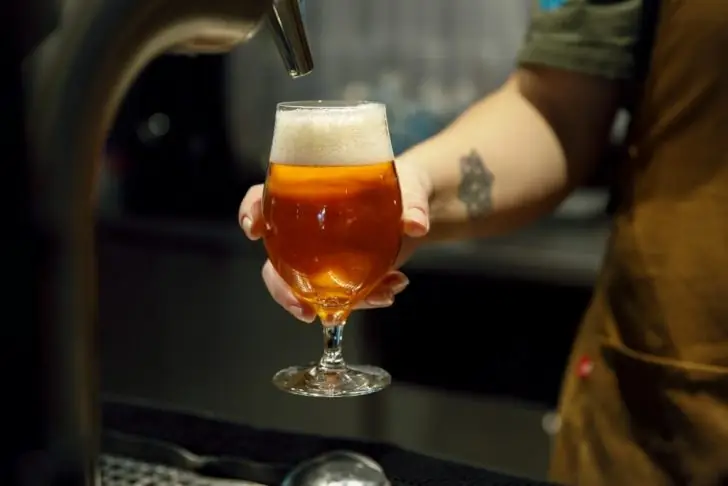
However, the key difference lies in how fermentation intensity affects the structure of Liquid Transfer Protein 1 (LTP1), a barley-derived protein that survives the malting and brewing process. In single-fermented lagers, LTP1 proteins maintain their native globular form, arranging themselves as small, spherical particles on bubble surfaces.
Surface Properties and Stabilization Mechanisms
The study showed that foam stability isn’t governed by the same mechanism in every beer. In lagers that undergo a single fermentation, surface viscosity matters most. Proteins boost this viscosity, creating thicker films around bubbles that slow down collapse.
In triple-fermented ales, however, viscosity plays only a minor role. Instead, stability comes from Marangoni stresses—currents driven by surface tension differences that keep bubbles reinforced and circulating.
This contrast explains why simply raising protein levels doesn’t always guarantee better foam.
Protein Content & Composition
Protein makeup remains central to foam behavior. LTP1 stands out as a key player, but several other proteins also influence how stable or thick the head becomes.
Protein Z and other grain-derived proteins help stabilize foam once it has formed, while hop iso-alpha acids have been shown to influence foam quality significantly.

Interestingly, for the “juicy IPA” category, there is evidence that polyphenols can negatively impact foam by binding with proteins that would otherwise be foam-positive.
Yeast Influence on Foam Characteristics
Yeast strains also contribute significantly to foam properties. During extended contact with beer, yeast can enzymatically break down LTP1, reducing foam stability. This is especially common with unhealthy yeast that has been starved at the bottom of large tanks. Conversely, some yeasts actively enhance foam quality.
Lager yeasts contain a gene called CFG1 (Carlsbergensis Foaming Gene) that codes for a mannoprotein on the yeast cell surface. This protein “sticks” to bubble surfaces, preventing them from draining and thus stabilizing the foam.
Ale yeasts have similar proteins, though they are less well characterized. All commercially available lager strains from Escarpment Labs have been confirmed to carry the CFG1 gene, making them “certified foam-positive.”